Back to School | Math | Reading | Winter | Writing
Writing Prompts with Editable Word Banks
So many times when my students begin their writing, they want help spelling certain words. I always remind them to not worry about spelling difficult words when they are writing. I don’t want them to shy away from using words that they are unsure about. My main focus during writing is the writing process, not spelling. {I want them to spell taught words correctly.}
I like to write some “common” words on the board that I know my students may need if we are writing to a particular topic. For this reason, I began creating writing prompts with Word Banks.
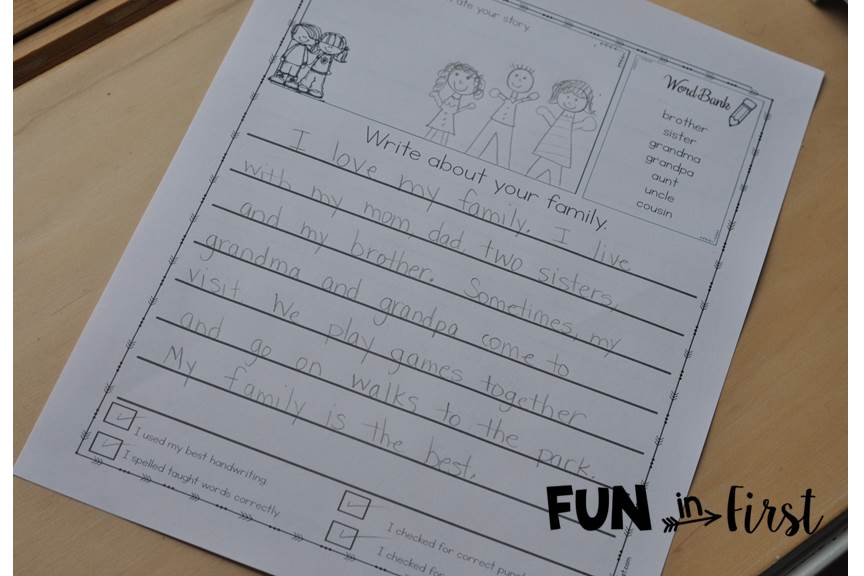
As I started working on these, I began to realize that I may want to edit these word banks for different students in my classroom. I also may want to change the list of words each school year depending on current situations.

So, the word banks on each of the writing prompts are completely editable to fit your needs.
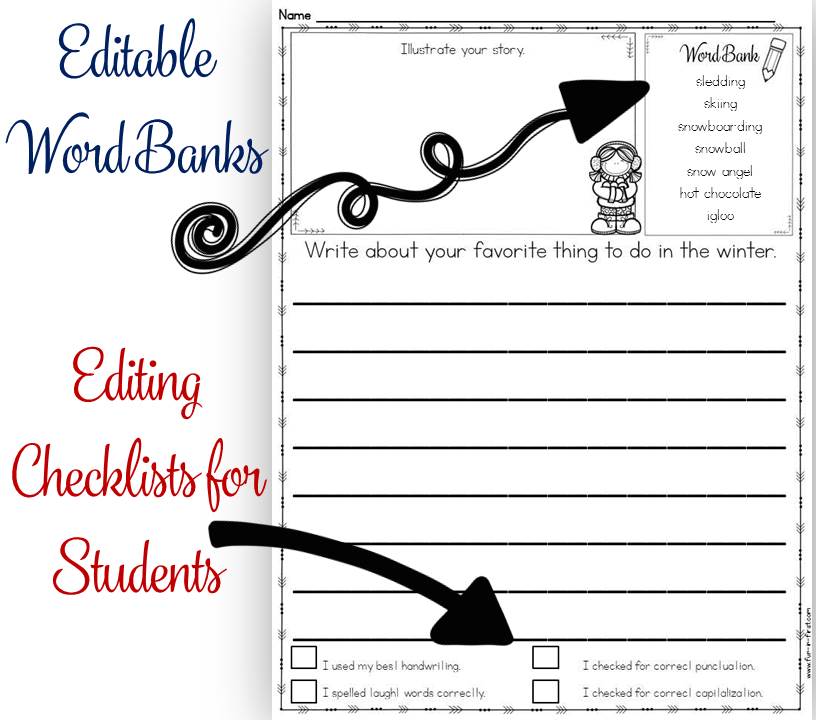
Each of the 48 prompts also include an editing checklist for my students to check their work.

You can check out the entire packet by clicking on the picture below.


Jodi,
I love your writing ideas. Writing is probably the hardest part of teaching first grade, for me. I think students not being able to organize their thoughts, is most likely the biggest challenge for young writers. Your “Write the Rainbow” activity is an excellent way for students to clearly see the order necessary to write a story. I can’t wait to try it!
I also think your “Word Bank Writing Prompts” are a fantastic way to help students who tend to not be able to move forward once they hit a word they can’t spell. So many of my students stop dead in their tracks and are completely unable or won’t move on, unless they spell a word correctly. I always make a word bank on my board, but early in the year it is difficult for my students to find the word they need amongst the list. I am hoping these prompts help with that situation.
Thanks so much for all the great ideas!
Thank you! I agree with the spelling issue. I try to explain to my students that I’ve been teaching 1st grade for a long time, and I will be able to tell what they are trying to spell. Lol!
Using make my concept map for me alongside writing prompts with editable word banks can significantly aid research. It helps organize ideas visually, making complex topics easier to understand. Customizable word banks provide flexibility, allowing researchers to explore various perspectives. This approach enhances creativity and ensures a comprehensive exploration of the subject matter, leading to more insightful writing.
I am very impressed with the author’s ability to analyze and synthesize. The article is both concise and covers all important content. In particular, the conclusion summarizes the main idea to help readers remember it more easily. This is the type of content I am always looking for. papa’s games
Writing Prompts with Editable Word Banks is so nice to tell us what we are required to deal with. When I used colour consultation to learn how we are dealing with these ideas to get the amazing solutions we are required.
Writing Prompts with Editable Word Banks is so nice to tell us what we are required to deal with. When I used Gosford to learn how we are dealing with these ideas to get the amazing solutions we are required.
Writing Prompts with Editable Word Banks is so nice to tell us what we are required to deal with. When I used colour consultation to learn how we are dealing with these ideas to get the amazing solutions we are required.
The 48 prompts with editable word banks are a lifesaver. I was thinking about how to make teaching more fun, and AI Video Generator seems like a cool tool to try. While sipping coffee, I wondered if my students would enjoy it as much as I do.
So, why do we still even care about Lorem Ipsum? It’s just filler, right? Designers should focus on real stuff, not this ancient text.
Editable word banks are such a clever scaffold — they lower the barrier for reluctant writers while still giving them ownership of the story. The ability to differentiate for different levels within the same activity is exactly what makes this resource stand out.
Editable word banks are such a smart accommodation — giving students a scaffold for spelling while keeping their creative flow going addresses exactly the frustration that makes reluctant writers shut down. I’ve been exploring how speech-to-text tools like WhisperWeb could complement this approach for students who express themselves better verbally. Wonderful resource for early elementary!
Great breakdown of the capabilities here. AI tools for creative tasks have improved dramatically, and clear comparisons help users find the right fit for their needs.
These editable word bank writing prompts are a brilliant differentiation tool — the scaffolding flexibility means the same prompt works across ability levels. I’ve been creating classroom strategy videos using Omni Video, and primary education content consistently gets strong engagement from teacher communities on social platforms.
These editable word bank prompts are a brilliant resource — giving kids vocabulary scaffolding while still letting them construct their own sentences hits exactly the right balance for differentiated instruction. I’ve been putting together visual learning materials for first-grade literacy and found that pairing prompts with simple 3D scene illustrations (created with SAM 3D) really helps reluctant writers picture their story before they write it.
Many students trust Share Market Skills for the Best Share Market Course in Ghaziabad, Uttar Pradesh because of their practical and result-oriented teaching methods.
Looking for professional stock market training in Ghaziabad? Sharemarket skills Academy provides beginner to advanced training with live chart analysis and mentorship.
Fresh poppy pods are the seed pods that are harvested from the poppy flower. Poppies are known for their beautiful flowers, but it’s their seed pods that are of the most value. These pods contain the seeds for the next crop and, when dried, they are frequently used in floral arrangements and other decorative crafts. By using fresh poppy pods, you can take your art to the next level as it gives a natural and pleasant look to your creations.
Good points on Writing Prompts with Editable Word. Accurate transcription via Whisper AI has helped me reference spoken content without replaying recordings repeatedly.
The editable word banks are such a smart scaffold — they lower the cognitive load just enough for reluctant writers while still leaving room for creative decisions. I used Nano Image to generate quick illustration thumbnails alongside one of these prompts during a literacy station and the students loved having a visual anchor.
Restore Old Photos is a professional service that brings your precious memories back to life with advanced photo restoration technology
AI Image Editor is a powerful AI image editor for restoring and enhancing images.
Editable word banks are such a smart scaffold for reluctant writers — giving them just enough structure without doing the thinking for them. I recorded a set of writing-prompt read-alouds for my class last semester and used Miso One to generate the audio; the students loved hearing the prompts in a clear, expressive voice before writing.
Thoughtful piece — I’ve been thinking about similar topics lately. When I was documenting some related work, I found GetImgAI really helpful for quickly prototyping visual mockups. Your perspective here adds a useful dimension to the discussion.
Love the aesthetic you’ve captured here! The personal commentary makes it feel so much more authentic than a standard lookbook. I used Nano Banana AI recently to prototype some fashion editorial images — really pleased with the results.
Editable word banks are such a practical solution for differentiated writing instruction — students who struggle with spelling can focus their cognitive energy on composition rather than mechanics. The printable format makes this easy to drop into any writing block. I recently used Nano Banana Pro to generate custom illustration sets to pair with similar writing prompts, and the AI handled the varied themes really consistently.
Smart instructional design — editable word banks scaffold vocabulary while leaving room for creativity. I create classroom resource videos using HappyHorse AI. Fantastic teaching tool!
Love this approach — taking the spelling pressure off so kids focus on the writing process is exactly what young writers need. Editable word banks are such a practical touch for differentiation. I made a short animated version of one prompt with VEO 4 to project on the board, and the kids were instantly more engaged.
Very informative and well-written. You explained the topic in a simple yet insightful way. Excited to see more posts like this in the future!
Editable word banks are such a practical differentiation tool — they lower the activation energy for reluctant writers without removing the cognitive challenge of idea generation. The scaffolding disappears gradually as students internalize vocabulary patterns. I tried using Qwen3 TTS to read the prompts aloud while students draft, and it actually helped kids who struggle with print decoding stay focused on the writing itself rather than re-reading the prompt repeatedly.
These writing prompts with editable word banks are such a creative differentiation tool — giving students vocabulary scaffolding while still letting them write freely is a perfect balance. I’ve been creating illustrated prompt cards for my classroom and using Image2Image to turn simple clipart into more polished illustrative styles. The kids respond really well to the visual storytelling element.
Editable word banks are such a clever scaffolding tool — students feel supported without being over-directed, and it makes differentiation so much easier in a mixed-ability class. These prompts look engaging and well-structured. I recently made a short explainer video about classroom writing strategies using Seedance AI Video and it really helped illustrate the concepts.
Editable word banks are such a clever scaffolding tool — students feel supported without being over-directed, and it makes differentiation so much easier in a mixed-ability class. These prompts look engaging and well-structured. I recently made a short explainer video about classroom writing strategies using Seedance AI Video and it really helped illustrate the concepts.
These editable word bank writing prompts are such a clever resource for first grade teachers — giving students a vocabulary scaffold makes the writing process so much less intimidating. I recently made a short classroom activity explainer using Kling 3.5 to show how writing prompts can be used with visual cues, and it worked really well for teacher training sessions.
Editable word banks are such a clever differentiation tool — they scaffold writing for students who need support while allowing individual creative expression. The ability to customize vocabulary means these prompts can be adapted to any classroom level. I’ve been pairing prompts with visual story starters generated by Nano Banana 3 to spark even more imagination.
The editable word banks are such a clever solution for differentiation — the same prompt becomes genuinely accessible to multiple reading levels without obvious scaffolding. I’ve been adapting these kinds of visual prompts into short video content using Grok Imagine Video 1.5, which pairs really well with student writing exhibitions.
Editable word banks are such a smart scaffold for emergent writers — they provide just enough support to get ideas flowing without doing the creative work for the student. The ability to differentiate vocabulary by ability level makes this particularly flexible for mixed classrooms. I adapted a similar approach for audio prompts using OmniVoice for students who benefit from hearing the words read aloud.
The editable word banks are such a clever solution for differentiation — the same prompt becomes genuinely accessible to multiple reading levels without obvious scaffolding. I’ve been adapting these kinds of visual prompts into short video content using Grok Imagine Video 1.5, which pairs really well with student writing exhibitions.
The editable word banks are such a clever solution for differentiation — the same prompt becomes genuinely accessible to multiple reading levels without obvious scaffolding. I’ve been adapting these kinds of visual prompts into short video content using Grok Imagine Video 1.5, which pairs really well with student writing exhibitions.
The editable word banks are such a clever solution for differentiation — the same prompt becomes genuinely accessible to multiple reading levels without obvious scaffolding. I’ve been adapting these kinds of visual prompts into short video content using Grok Imagine Video 1.5, which pairs really well with student writing exhibitions.
Editable word banks are such a smart scaffold for young writers — giving them vocabulary pieces to experiment with reduces blank page paralysis significantly. The variety of prompt themes keeps the activity fresh across the school year. For audio versions of writing prompts, we’ve used VoxCPM to produce multilingual TTS narration that students can listen to as well as read.
Excellent tips! Creating a focused environment is so underrated. For the visuals I use in educational materials, GetImgAI Online has been my go-to for clean, AI-generated graphics that keep students engaged. Your practical advice pairs really well with good visual aids.
I don’t usually spend much time reading blog posts, but this one genuinely captured my attention from the very beginning. The way you presented your ideas kept me engaged all the way through without losing interest. Your writing is clear, engaging, and refreshingly enjoyable, making the entire piece a pleasure to read. It’s rare for me to stay focused on a post like this, but yours truly stood out and made a lasting impression overall.
The reasoning you lay out here holds up well – the specific classroom examples help ground the argument. I have been producing audio explainers for teaching resources using Seed Audio, and posts like this are a great model for making educational content engaging.
Thank you for making such a strong case here. On the visual side of education content, I’ve been experimenting with Banana Pro AI for custom imagery and the 4K output is presentation-ready.
I love how your editable word banks give students the confidence to write without getting stuck on spelling. It’s such a practical way to support the writing process. As a teacher always looking for creative hooks, I’ve found that pairing writing prompts with unexpected tools can really engage reluctant writers. For instance, we sometimes start with a quick personality snapshot from an [AI palm reader for personality insights] to generate character ideas, then students use the word banks to describe their created character. It turns a routine prompt into something they’re excited to write about. Thanks for sharing such a versatile resource.
Writing prompts are much easier to develop when spoken classroom ideas can be saved and reviewed later. NeatScribe can help turn voice notes or lesson discussions into text.
Editable word banks are such a smart middle ground — kids get support without losing the habit of writing through unfamiliar words. I’ve been using Fine Voice to read the prompts aloud for a couple of students who benefit from hearing the words before spelling them. Thanks for sharing the templates.
Editable word banks are such a smart fix for that spelling anxiety — letting kids focus on getting ideas down instead of freezing over how to spell a word. I did something similar for my reading center, dropping the prompts into Fine Voice to create narrated versions for students who need audio support.
These editable word banks are such a smart scaffold for reluctant writers, I love that it removes the blank-page anxiety while still building vocabulary. I’ve been prepping visual writing prompt cards with Seedream 4.5 for my own classroom centers and it pairs really well with this approach. Thanks for sharing such a practical resource.
Editable word banks are such a simple fix for the thing that stalls beginning writers the most — not the ideas, but the fear of misspelling a word they actually want to use. This is a great low-prep way to keep momentum during independent writing time.
The point about not wanting kids to shy away from harder vocabulary just because spelling is uncertain is such an important distinction for early writers—process over perfection. I used GPT Realtime 2 to draft narration for a short read-aloud version of a similar word bank activity for my own class, just a small side project. Editable word banks like this make differentiation so much easier during independent writing time.
The writing prompt idea is practical because editable word banks give students structure without taking away choice. It is a useful way to support reluctant writers while still keeping the writing task open-ended.
I found this useful, especially the part about WRITING PROMPTS WITH EDITABLE WORD BANKS. The article explains the topic clearly and makes the main points easy to follow.
https://www.thebuyerpro.com
The Buyer Pro is a buyer-focused website designed to support purchase decisions and product research. It can be used for shopping guidance, comparisons, and consumer-oriented content. The site is suitable for promotional campaigns in commerce and product discovery.
https://www.texttocsv.com
This website converts plain text into CSV format for faster data handling and organization. It is useful for spreadsheet work, structured data cleaning, and simple automation tasks. The tool is practical for users who work with tables, lists, and imported text data.
Editable word banks are such a smart way to keep kids in the writing flow instead of stalling out on spelling. I like that you separate the writing process from spelling accuracy for words you haven’t taught yet, that distinction makes a real difference for early writers’ confidence. When I’m making picture prompts for my own word bank sheets, I use Muse Image to generate quick reference images for the vocabulary cards.
I appreciate the idea of editable word banks to differentiate for students. Do you find that having the checklist on the same page helps them remember to edit, or do they still skip it? I’ve been experimenting with separate checklists and wonder if combining them works better.
I really appreciate the practical approach you’ve taken with editable word banks to support young writers. It’s a thoughtful way to balance spelling support without stifling creativity. For educators looking to dig deeper into how technology can enhance literacy instruction, I’ve found that exploring AI tools for educational research offers valuable insights on customizing learning resources. Platforms like AI tools for educational research aggregate the latest news and tools, which can inspire new ways to adapt classroom materials like these word banks for diverse student needs.
I really appreciate how you designed those editable word banks to support young writers without letting spelling hold them back—such a practical approach to building confidence. The idea of offering flexible vocabulary support reminds me of similar strategies we use for second-language acquisition, where learners need repeated, contextual exposure to new words. For anyone teaching Mandarin or learning it themselves, I’ve found that combining writing prompts with interactive language learning games is especially effective for internalizing characters and sentence patterns. That’s why I often turn to immersive Chinese practice games which turn vocabulary building into a playful, low-pressure experience—just like your word banks do for spelling. It’s amazing how giving students the right scaffolds at the right moment can unlock so much creativity.
I really appreciate how you emphasize the writing process over spelling accuracy—that’s such a crucial mindset for young learners. Editable word banks are a great scaffold, and I’ve found that pairing them with visual diagrams can further help students organize their thoughts before they write. For teachers who want to create custom graphic organizers, story maps, or sequencing charts to complement these prompts, tools like visual story mapping tools make it easy to generate professional-looking diagrams with just a few prompts, then export them as SVGs for further editing. It cuts down prep time while supporting student comprehension, especially for those who need extra structure.
Your editable word banks are such a practical way to support young writers without letting spelling slow them down. I’ve found that giving students a framework for their ideas really boosts their confidence. For those who enjoy creative storytelling, I’ve also used resources like palm reading personality insights to help students think about character traits and backstories in a new way. It’s amazing how connecting writing prompts to real-world subjects like palmistry can spark their imagination and make the writing process even more engaging.
The editable word-bank component is brilliant for differentiation — lower writers get the scaffold while on-grade peers can work past it. I’ve been using Fish Voice to create read-aloud versions of the prompts for students who process better through listening, and the combination has been a genuine engagement win in my first-grade class.
Great perspective on AI tools in the workflow. I’ve been integrating Speech Notes for transcribing brainstorming sessions — the ability to search through recordings later has genuinely changed how I work.
Editable word banks are such a smart scaffold for young writers — they remove the ‘I don’t know what to write’ blocker without taking away creative agency. I’ve been recording my students’ brainstorming sessions and using GPT Transcribe to convert the audio to text for analyzing thinking patterns. The combination with structured prompts like these makes differentiation so much easier.
Good read with practical depth. I’ve been building out a visual content workflow using Krea 2 Turbo Online and the AI handles a surprisingly wide range of styles effectively.
The framing you’ve used here is quite elegant. It recontextualizes something I thought I understood and opens up new angles to consider. — I’ve been using Krea 2, an AI image generator, to create visuals for related projects and found it surprisingly capable for style-controlled image work.
Solid overview. We recently started using Krea 2 Turbo for fast concept visualization and it’s changed how we approach early creative work — the image-to-image feature especially helps iterate quickly.
These editable word banks are such a smart scaffold for reluctant writers — giving just enough structure without taking away the creativity. I work with audio content and often use Audio Convert to transcribe students’ spoken story drafts into text they can then edit, which really bridges the gap for kids who think faster than they type. Thanks for sharing these in an editable format!
The idea of making the word banks editable is really practical for differentiation. It can be challenging to balance encouraging creative vocabulary with the frustration some students feel when they do not know how to spell a word they want to use. Being able to tailor those lists for different learning levels or specific classroom needs seems like a helpful way to keep the focus on the writing process itself.
I appreciate the emphasis on letting students use ambitious vocabulary without fear of spelling errors. The editable word banks are a clever solution for differentiating support, especially since the same prompt can be adapted for different levels or interests. Have you considered using a tool to generate additional themed word banks or prompts, which could save time when preparing for new topics? An AI-powered generator might offer fresh ideas that align with your curriculum. AI writing prompt generator
I appreciate the idea of editable word banks for writing prompts, especially for differentiating instruction. I’ve been looking for ways to support emerging writers without limiting their vocabulary choices. The editing checklist is a nice addition too, as it encourages independence. Have you considered using these with a digital tool like Google Slides for remote learning? this article might offer some inspiration for integrating such resources into a tech-friendly classroom.
[object Object]
For teachers juggling young writers who freeze at tricky spellings, this page offers a practical, time-saving solution—48 fully editable writing prompts with word banks and built-in editing checklists, perfect for first-grade classrooms and differentiated instruction.
If you’re an educator always hunting for ways to keep writing flowing without stopping for spelling help, this resource is worth a look. The editable word banks mean you can tailor vocabulary to each student or season, which is a thoughtful touch. I’ve found that similar small supports make a big difference in student confidence.
On a related note, for anyone managing the physical aches that come with long days on your feet—whether at the front of a classroom or elsewhere—I’ve come across solid copper bracelets with magnets designed for joint comfort and everyday wear. They make a practical gift for a fellow teacher or a treat for yourself. Check them out here:
MagnetPure wellness jewelry
Editable word banks are such a smart differentiation tool — it gives every student a scaffold without locking them into the same vocabulary. I love how this resource can be adapted for different ability levels. For teachers who record read-alouds or dictation exercises, Speech Text converts audio into text transcripts that students can work from directly.
The editable word banks are such a practical solution for differentiating writing support without singling anyone out. I’ve found that letting students see the words visually, rather than just hearing them, really helps my struggling spellers take more risks in their drafts. Have you considered pairing these prompts with a tool that could turn their finished stories into short animated clips? It might add an extra layer of motivation—something like ai video could let them see their characters come to life, which might make the editing checklist feel more purposeful. Either way, thanks for sharing this resource; the 48 prompts sound like a solid foundation for a year of writing centers.
This is so helpful! I always want to spell words for my students quickly. Another thing that helps is using visual prompts. Have you tried a Free AI Image Editor to make pictures for vocabulary? It’s quick and easy, and the kids love it.
This is so helpful! I always want to spell words for my students quickly. Another thing that helps is using visual prompts. Have you tried a Free AI Image Editor to make pictures for vocabulary? It’s quick and easy, and the kids love it.
Thanks for sharing this article. It was a clear and useful read. Minecraft skin tools may also be useful for readers interested in this topic.
Thanks for sharing this article. It was a clear and useful read. old photo restoration may also be useful for readers interested in this topic.
What a clever resource for early writers — editable word banks lower the barrier to entry while still encouraging creative thinking. I use a similar scaffolded approach in my classroom. Last year I added audio read-alouds of the prompts using Eleven AI, and students with reading challenges found it so much easier to engage independently.
Really thoughtful article! For educators creating accessible content, Voice Art has been a great tool — it converts lesson materials to natural audio for students who prefer listening.
The point about publication dates impacting reader trust is something a lot of bloggers underestimate. This is solid practical advice that I’ll be sharing with my content team. We’ve been using Voice Art to turn written blog posts into audio versions — it’s a straightforward way to reach audiences who consume content while commuting or exercising.
This is a great strategy to support young writers. I wonder how effective the editable word banks are for students who struggle to initiate writing independently, even with some scaffolding. It’s a fantastic idea for differentiating instruction. On a related note, when I’m trying to visualize complex ideas for my own projects, I often find the tools at Text to Image helpful for generating initial concepts.
The editable word banks are a clever way to differentiate for varying student needs. I’m curious if you’ve found specific words that consistently trip students up, regardless of the prompt topic? Beyond just spelling, it’s a challenge to maintain fluency when word recall is slow. For my own brainstorming, I’ve found some creative video tools to be surprisingly effective for generating initial concepts when stuck on a visual idea. Slightly off topic, but if you ever deal with AI movie maker, some creative video tools is what I ended up settling on and it has saved me a fair bit of time.
It’s insightful how you’ve made the word banks editable, catering to individual student needs. I’ve found that for students who are hesitant to start, having a structured visual aid like this is crucial. Sometimes, even with prompts, the blank page can be intimidating. For my own creative processes, I’ve found a handy a workflow tool incredibly useful when I need to quickly visualize abstract concepts.
It’s interesting how you’ve focused on empowering students to spell common words correctly within their writing. I wonder if you’ve noticed a difference in their willingness to attempt more complex sentence structures when they feel more secure about their vocabulary choices. For my own process of generating diverse visual assets quickly, I’ve found pix-bulk.com to be incredibly efficient for scaling content creation.
It’s interesting how you’ve focused on empowering students to spell common words correctly within their writing. I wonder if you’ve noticed a difference in their willingness to attempt more complex sentence structures when they feel more secure about their vocabulary choices. For quick and high-quality visual asset generation, I’ve found that generative AI image creation is surprisingly effective for scaling content production.
focusing on the writing process instead of just spelling is a much better approach for kids. the editing checklists in these figure out how long something took prompts are a nice touch too.
thanks for your share bro,usefule
thanks for your share bro,usefule
thanks for your share bro,usefule
It’s thoughtful how you’ve focused on providing editable word banks to support students with spelling common words. I’ve often wondered if giving students that foundational spelling confidence frees them up to experiment more with sentence structure. For my own projects needing rapid visual development, fast, low-cost 1K image generation has been a game-changer for iterating quickly.
I truly appreciate you sharing such helpful and well-organized information. The content is clear, reliable, and valuable, offering readers trustworthy resources. Your effort and dedication are evident, making a meaningful difference and providing genuine value to your audience.
It’s interesting how you’ve focused on empowering students to spell common words correctly within their writing. I wonder if you’ve noticed a difference in their willingness to attempt more complex sentence structures when they feel more secure about their vocabulary choices. For my own creative endeavors, I’ve found these AI song creation tools incredibly useful for generating background music for my projects. Slightly off topic, but if you ever deal with text to song, AI song creation tools is what I ended up settling on and it has saved me a fair bit of time.
It’s interesting how you’ve focused on empowering students to spell common words correctly within their writing. I wonder if you’ve noticed a difference in their willingness to attempt more complex sentence structures when they feel more secure about their vocabulary choices. When I’m working on my own creative projects and need background music, I’ve found that full song creation is a surprisingly effective way to quickly generate suitable audio from text prompts.
It’s interesting how you’ve focused on empowering students to spell common words correctly within their writing. I wonder if you’ve noticed a difference in their willingness to attempt more complex sentence structures when they feel more secure about their vocabulary choices. For my own creative endeavors, I’ve found these AI song creation tools incredibly useful for generating background music for my projects. Slightly off topic, but if you ever deal with text to song, BulkGen is what I ended up settling on and it has saved me a fair bit of time.
Editable word banks are such a smart way to support different confidence levels without changing the core prompt. Letting students swap in words tied to characters or topics they already love can make the first sentence much less intimidating.
Dawnwalker Wiki These editable word-bank prompts are a practical way to help young writers get started without getting stuck on spelling. I especially like the built-in editing checklist for guiding students through revision.
I like how these writing prompts use editable word banks to support spelling while keeping students focused on the writing process. The flexible word choices seem like a great way to help young writers build confidence.
Onimusha Wiki
The editable word banks are a smart way to differentiate without changing the prompt itself. I am curious how you decide which words go on the bank for a given prompt, and whether students eventually stop relying on them as their spelling improves. Do you keep the same word bank across the year or swap words in and out based on the class?
A straightforward resource for Restore Old Photos with AI, especially when the main problem is fading, blur, or general aging.
The flow at https://aiimage-editor.org/ is helpful for trying product scenes, social visuals, and image-to-image variations.
A practical resource for this image improvement page, especially when a picture needs clearer detail and better tone.
The flow at this online concrete calculator is helpful for checking volume, bags, weight, and cost in one place.
A practical resource for this browser games platform, especially when no download or account setup is needed.
It is helpful to have https://heic-tojpg.com/ when multiple Apple photos need JPG versions.
The flow at Image to Image AI tool is helpful for upscaling, restoring, restyling, and previewing image changes online.
It is useful to have Flux Kontext AI Image Generator when testing several creative directions from the same source image.
The editable word banks give students a starting point without deciding the whole story for them. The same approach could support a short visual-story prompt: keep a few action and setting words available, then let the student explain what happens before and after the scene.
A focused resource for fix torn old pictures, especially when the image is faded, torn, scratched, or blurry.
The workflow at AI video preview and export tool is helpful when a creator wants to compare several short video directions before publishing.
The editable word banks are useful because the vocabulary can change without rebuilding the whole prompt, and the student checklist keeps that editing step visible. For a teacher’s own flattened photo prompt when the source file is unavailable, our tool can remove captions from photos before adding a fresh word bank; the editable original remains the better option, and any reconstructed background needs checking.
A straightforward resource for Restore Old Photos online, especially when the main problem is fading, blur, or general aging.
The point about not letting spelling concerns stop students from using words they are unsure of seems like a difficult balance to maintain, especially when the writing process is the main focus. Do the editable word banks work with any prompt, or are they designed around specific topics? I ask because a keyboard speed test made me think about how word banks and typing practice might overlap for students who are still building speed and accuracy.
A practical option for edit images with AI when you want quick prompt-based changes in the browser.
The point about not wanting students to shy away from words they can’t yet spell is what makes the editable word banks feel useful rather than restrictive, since the list can grow with the topic instead of capping what kids attempt. I’m curious how the 48 prompts are organized across the year, and whether the editing checklist stays the same for each one or changes with the genre. I’ve been looking at how a collection of teaching resources handles similar skill-by-skill breakdowns, and it made me wonder whether the word banks are meant to be swapped per student or kept consistent for the whole class.
A practical resource for https://ai-photoenhancer.com/, especially when a picture needs clearer detail and better tone.
A practical option for concrete estimate calculator before ordering materials for slabs, footings, or patios.
Keeping the word bank editable for each learner is a useful distinction: the support can change without dictating the story. For bilingual comic-writing activities, a teacher could prepare a small vocabulary bank from an age-appropriate panel, then let students write their own dialogue before comparing a translation. We develop this manga translation extension, and would keep that comparison separate from the first draft, just as you separate spelling support from composing.
It is useful to have Free Games Online browser games for quick casual sessions across desktop and mobile devices.
Editable word banks solve the exact problem where a child freezes on one word and abandons the idea. Keeping the focus on the writing process rather than perfect spelling is the right call at that age. I used the same “give them the vocabulary up front” principle when generating a short classroom clip from a single photo with Z Video — fewer decisions up front means more finished work.
It is helpful to have HEIC to JPG Converter when multiple Apple photos need JPG versions.
The flow at https://image-to-image-ai.org/ is helpful for upscaling, restoring, restyling, and previewing image changes online.
A practical resource for this image generation workflow, especially when character consistency or local control matters.
A focused resource for this browser-based photo repair tool, especially when the image is faded, torn, scratched, or blurry.
Thanks for putting this together — WRITING PROMPTS WITH EDITABLE WORD BANKS is one of those subjects where the details really matter, and you explained the practical side well. I’ve been testing quick AI-generated concept clips for a similar project and used Happy Horse AI to previsualise a few shots; seeing the idea move made the whole thing click.
The editable word bank idea solves the real problem, which is that spelling anxiety stops kids from getting sentences onto the page at all. Keeping the bank editable so it can be tailored per unit is what makes it reusable rather than a one-off worksheet. I would love to see how you handle the transition when students no longer need the scaffold. También convertí algunas de las tarjetas de consignas en una introducción corta en vídeo con Seedance 3 para la pantalla del aula, y mantuvo la atención mejor de lo que esperaba.
Making the word bank editable for individual students keeps vocabulary support flexible without deciding the story for them. For a picture-prompt variation, a teacher could create ai characters from text and invite students to choose their own action words and ending; the editing checklist could still be used after the first draft.
The workflow at Sora 2 is helpful when a creator wants to compare several short video directions before publishing.
Really useful tool — Picture Enhancer sharpened my blurry shots in the browser without a watermark. Worth trying: https://pictureenhancer.online/
The flow at https://square-facegenerator.com/ is helpful for adjusting face shape, hair, eyes, colors, and accessories in one place.
Making the word banks editable is a practical way to keep the same prompt useful for different students and new school years. It also shows why saving an editable master is better than repeatedly changing a flattened worksheet image. If someone only has a flattened copy of a worksheet they created themselves, our Remove Text tool can help prepare an area for replacement wording, but your editable approach avoids that cleanup step and keeps the checklist intact.
Word banks are such an underrated scaffold — they give hesitant writers a lifeline without doing the thinking for them. The editable part is key, since every class has its own vocabulary gaps. I was making a matching set of illustrated prompt cards for my group and used Nano Pro to clean up the artwork so the images printed sharply.
You presented everything so well. Really appreciate the effort.
Buy korean botox online
You did a fantastic job with the layout of this article. The pacing of your writing is great, and you explained the details in a completely straightforward way.
Innotox 50U
A practical option for enhance photos online when faded or blurry images need clearer detail.
The flow at Concrete Yard Calculator tool is helpful for checking cubic feet, cubic yards, volume, and planning weight in one place.
The editable word bank offers a useful way to adapt the same writing idea without prescribing every sentence. A teacher preparing a visual prompt with our AnimateImg seedance 2.0 workspace could make a short scene around a fictional animal performing one clear action, then select a few matching nouns and verbs for the bank. I would review the clip beforehand and leave the ending open, so the visual supplies a starting point while the students still decide what happens in their stories.
Making the word bank editable gives children room to choose language without deciding the whole story for them. When adapting ideas from our ToviStory storytelling blog, I would offer a few character, setting and action words, let the child tell the next event in their own words, and save the editing checklist for a second pass so spelling support does not interrupt the first burst of ideas.
The point about keeping the focus on the writing process rather than spelling really resonates, and I’m curious how the editable word banks work in practice. Do you find that students rely on the word bank as a scaffold and gradually stop needing it, or does it tend to stay in use throughout the year? Also, when you edit the banks for different students, do you differentiate by reading level, by topic familiarity, or by something else entirely?
The flow at preserve vintage family pictures is helpful for scanned family albums and vintage prints that need a clearer before-and-after result.
The editable word bank gives children useful spelling support without deciding their whole story for them. A kinetic typography generator could introduce a few topic words one at a time before writing begins, followed by a still version they can consult at their own pace. I would keep the editing checklist for the review stage so the moving prompt does not interrupt their first draft.
Editable word banks address a very specific problem: pupils can keep developing an idea without stopping at every unfamiliar spelling. The editing checklist also gives them a separate moment to revisit the finished draft. I would be interested in an example of two different word banks for the same prompt, showing how you keep the writing goal shared while adjusting the support.
The editable word banks address a specific problem: children can keep developing an idea without being limited to words they already spell confidently. Pairing that support with a separate editing checklist also makes the difference between drafting and revising much clearer.
Making the word banks editable seems particularly helpful when two children have the same idea but different vocabulary needs. Keeping the editing checklist separate also gives them a clear second step, so choosing an ambitious word does not have to interrupt the first draft.
Making the word banks editable addresses a practical issue that a fixed list cannot: different students may need different vocabulary for the same prompt. The accompanying checklist also gives the writing stage and the editing stage distinct purposes without making spelling the barrier to getting an idea onto the page.
This is a helpful idea for writers. Editable word banks can make writing prompts more flexible and help generate new ideas quickly. A useful resource for anyone looking to improve their creative writing process.
This post on writing prompts with editable word banks really resonates with the challenge of helping students organize their thoughts clearly. Just like customizable word banks give young writers the flexibility to express ideas without getting stuck, modern AI tools can take that creative freedom even further. I recently came across GeminiOmniFlash, a platform that transforms text, images, audio, and video into polished video content. It’s a fascinating next step for storytelling—imagine students turning their written prompts into short videos. Worth exploring if you’re curious about where creative writing and technology are heading.
This is such a practical approach to early writing instruction. The editable word banks are a smart touch—giving students the vocabulary support they need without limiting their creativity. It’s refreshing to see a focus on the writing process rather than perfect spelling. For anyone exploring how AI can complement creative tools like this, I’ve found MiniMax3 really useful for turning text and images into cinematic videos with native audio. It’s a different medium, but the same principle applies: give creators the right tools, and they’ll surprise you.
Leaving a few blank spaces in each editable word bank could let children add words from their own story ideas, so the support does not become a list everyone feels obliged to use. I also like separating the writing stage from the editing checklist. It would be interesting to see how you decide which words belong in a shared class bank and which are better added for an individual writer.
Smart concept writing prompts paired with editable word banks. It offers instant creativity boost while letting readers customize vocabulary to suit genre age or skill level. Great for classrooms writing groups or solo practice. I’d love to see example prompts mapped to different genres difficulty levels and editable templates that track progress. A practical resource that encourages risk taking, Xekoya discount code and steady improvement.
I love how these writing prompts with editable word banks remove the fear of spelling for young writers. The idea of customizing word lists for different students each year is brilliant and so practical. It reminds me of how tools like Wan3Video make storytelling more accessible by turning simple text prompts and images into cinematic videos—no technical skills needed. Both approaches empower creators to focus on ideas rather than obstacles. Whether in the classroom or digital storytelling, giving learners the right support makes all the difference.
The editable word bank idea is smart, but I’d argue the real bottleneck for young writers isn’t spelling—it’s generating the scene. Tools like DanseAI push this further by letting students upload two photos and instantly turn them into a short white-studio keyboard video, which sparks narrative ideas before the first sentence is written. Curious whether you’d pair that kind of visual prompt with the editing checklist you mentioned.
I love how your editable word banks solve the exact problem of students stalling when they can’t spell a tricky word. That same logic of removing friction from a creative task is what drew me to a tool that turns two photos into a 12-second tiptoe dance meme — one photo becomes the sneaky little man in curled shoes, the other the onlooker covering their mouth, all without a prompt or any editing.
The point about not letting spelling hold kids back really resonates. It’s the same idea behind tools like Bulin 47 AI, which lets anyone drop a single photo into that viral freestyle clip without needing editing skills or an app. Removing the technical barrier keeps the focus on creativity, not the tool.
The strategy of using editable word banks effectively lowers the barrier for young writers who often stall due to spelling anxiety. By allowing students to focus on narrative flow rather than perfect orthography, this approach encourages more confident and creative expression in early literacy stages. It is a practical method for balancing skill development with imaginative freedom in the classroom environment. Similar creative momentum can be found at rumpelstiltskin meme.
The strategy of using editable word banks effectively lowers the barrier for young writers who often stall due to spelling anxiety. By providing immediate access to necessary vocabulary, students can maintain their creative flow without constant interruptions for teacher assistance. This approach prioritizes idea generation over mechanical correctness in early drafts, which is crucial for building confidence. Similar tools for quick content creation are available at bulin 47 ai.
The post’s emphasis on editable word banks for early writing is practical, especially when students want help spelling certain words. The author’s reminder to not worry about spelling difficult words during drafting can reduce hesitation and keep ideas flowing. Providing a customizable bank also lets teachers match vocabulary to each prompt and learner. For a similar focus on flexible creation, ai creative platform offers one relevant option.
The editable word banks offer a practical way to keep students focused on ideas instead of getting stuck on spelling during writing time. The point about reminding kids not to worry about difficult words really stands out, since that anxiety often stops them from starting at all. Having those word banks ready seems like a simple but effective support for early writers. A related tool at hotel lobby ai turns a single photo into a short video.
This post on writing prompts with editable word banks is a great reminder of how much scaffolding matters in early writing instruction. The editable word bank idea is especially practical—teachers can differentiate for each student without recreating materials every year. I’ve found that pairing writing prompts with visual aids also helps reluctant writers get started, and tools like Nano Banana 2 Pro can generate custom images that spark ideas for story starters. It runs on Gemini 3, produces native 2K images with one-click 4K upscaling, and keeps characters consistent across scenes—useful for creating illustrated prompt cards. The editing checklist included here is a smart touch for building independence.
This is a fantastic approach to early writing instruction. The editable word banks are a smart way to remove the fear of spelling and let students focus on getting their ideas down. I’ve found that pairing tools like this with modern AI video generators can really help bring stories to life — for example, Kling 4 turns text or images into cinematic clips with native audio, which is a fun way to visually illustrate the writing prompts students create. It’s exciting to see how technology can support both literacy and creativity in the classroom.
The editable word bank solves a real problem — kids avoiding “hard” words because of spelling fear. But 48 prompts still means teachers rewrite lists every year. For anyone building custom zombie-themed AI video prompts, pairing those word banks with themed visuals could make the writing hook much stronger.
The editable word bank solves a real problem — kids avoiding “hard” words because of spelling fear. But 48 prompts still means teachers rewrite lists every year. For anyone building custom zombie-themed AI video prompts, pairing those word banks with themed visuals could make the writing hook much stronger.
The editable word bank solves a real problem — kids avoiding “hard” words because of spelling fear. But 48 prompts still means teachers rewrite lists every year. For anyone building custom zombie-themed AI video prompts, pairing those word banks with themed visuals could make the writing hook much stronger.
The point about not letting spelling hold kids back really resonates. It’s the same idea behind tools like Bulin 47 AI , which lets anyone drop a single photo into that viral freestyle clip without needing editing skills or an app. Removing the technical barrier keeps the focus on creativity, not the tool.
The strategy of using editable word banks effectively lowers the barrier for young writers who often stall due to spelling anxiety. By allowing students to focus on narrative flow rather than perfect orthography, this approach encourages more confident and creative expression in early literacy stages. It is a practical method for balancing skill development with imaginative freedom in the classroom environment. Similar creative momentum can be found at hotel lobby AI .
AI video from one selfie Word banks that students can edit themselves are a smart fix for the “I can’t spell it so I’ll stop writing” problem — that same spirit of removing roadblocks shows up in tools like Unforgettable Car AI, which skips the whole filming-and-editing hassle by turning one selfie into a 15-second car reveal video for TikTok and Reels. Giving kids editable vocabulary and giving creators one-tap video tools both come down to the same thing: less friction, more finished work.
AI football goal video I really like how you let students edit the word banks instead of locking them in for the year. That same idea of making one flexible template work for everyone is what drew me to a tool that turns a single uploaded photo into a 9:16 AI remake of Özil’s 2016 chip against Ludogorets, keeping the original clothes and adding the trend’s sound, no app or prompt needed.
three-shot dance video The point about editable word banks really resonates—scaffolding that adapts to each student is what makes writing prompts actually usable. That same principle of lowering the barrier between an idea and the final output applies to video too; tools like Gas Station Dance AI let anyone recreate the viral three-shot template from just a few photos, no filming or prompt-writing required.
SRD Grants Status Wow, this blog really reminds me of one I used to have! Even though the topic is completely different, the layout and overall design feel so similar, and the color combination looks great too.
This is such a helpful resource for early writers! The editable word banks solve a real classroom problem—kids getting stuck on spelling and losing their writing flow. I love that you can customize the lists for different students or topics each year. For teachers who also want to bring music into the classroom, Demucs Online is a fun free tool that splits any song into vocals, drums, bass, and other stems in about a minute—no software install needed. Could be a creative way to inspire writing about music or sounds. Thanks for sharing these prompts!
AI meme video maker The editable word banks are a smart fix for the “I can’t spell it so I’ll stop writing” problem, and the editing checklist keeps the focus on the writing process rather than perfect spelling. That same idea of lowering the barrier between an idea and a finished product is what drew me to tools like Raindance Maker, where you upload two photos and it recasts the seaside-pier Raindance trend video for you in 5 to 30 seconds, no filming or editing required. Both approaches let the creator stay focused on the story instead of the technical hurdles.
Tesla Roadster meme The point about not letting unfamiliar spelling stall a young writer is spot-on, and that’s exactly why a low-pressure creative tool can help—on Tesla Roadster AI, a single photo of a toy car or any vehicle becomes a 15-second ramp-flip video, no prompt or app needed, credits shown upfront, no watermark, and failed videos refunded. Kids get a quick creative win, then return to their word banks with momentum.
Tesla Roadster AI video generator What strikes me here is the point about not letting spelling fears stop a story — that same instinct applies to hesitant tech users, who freeze when a tool feels complicated. That’s why I like that RoadsterVideo needs just one photo and no prompt, with the credit price shown before you start and failed videos refunded; it keeps the focus on the creative result rather than the process.
I’m so with you on prioritizing the writing process over spelling—nothing shuts down my struggling writers faster than making them stop every sentence to ask how to spell something. The editable part is a game changer too, since I always end up wanting to tweak word lists for my ELL kids. Do you have students use the editing checklist independently right away, or do you model it whole group first?
This post really resonates with me. As a teacher, I’ve seen how word banks help students focus on the writing process rather than getting stuck on spelling—but I also struggle with finding enough time to build and customize them for every prompt. What’s worked well for me is pairing simple writing scaffolds with tools that handle the tedious parts automatically. For example, I’ve started using WhisperX to transcribe students’ oral storytelling and presentations with word-level timestamps and speaker labels, so I can quickly turn their spoken ideas into editable text. The transcript exports to TXT, SRT, VTT, or JSON, which makes it easy to drop into writing prompts or word bank activities. It saves me a ton of prep time and lets me focus on actual instruction instead of manual transcription. If you’re juggling writing prompts and editable word banks, this workflow is worth trying.
Thanks for this useful write-up. For anyone exploring AI video tools, I recommend checking out AI Video Generator — it is a straightforward option for generating short videos from text or images.
crazy frog police chase Editable word banks are a smart fix for the “I can’t spell it so I’ll stop writing” problem, and letting teachers swap words per student or per year makes them far more useful than a static list. I’ve noticed the same thing with quick creative tools — a 15-second Crazy Frog chase video built from just one or two photos, no prompting needed, appeals to students for the same reason: clear starting points lower the barrier to finishing something.
Such a smart way to support struggling writers! The word banks make writing so much less intimidating for first graders.
RNGdle number rarity game
Love this idea! Editable word banks are a game-changer for early writers—it gives them the confidence to actually get their thoughts on paper without getting stuck on spelling. Thanks for sharing this resource!
Text Compare for me!
Editable word banks are such a practical way to help first graders get started with writing prompts, since the vocabulary support takes away so much of the blank-page worry. I like that teachers can adapt the lists to their own class. For making matching classroom visuals I’ve been trying https://aiaigenerator.ai/ and it pairs nicely with ideas like this.
The point about not letting spelling worries stop kids from using ambitious words really resonates, and making the word banks fully editable so they can be swapped each year or tailored per student is a smart, practical touch. The built-in editing checklist on all 48 prompts also keeps the focus on the writing process. For sharing this kind of classroom material in a quick clip, a tool like alternative to Seedance 2.5 could turn a prompt and word bank into a short 30-second video for students.
This is such a helpful approach for early writers! I love how the editable word banks remove that “I can’t spell it so I’ll stop” barrier while still keeping the focus on the writing process. The built-in editing checklist is a smart touch too. For teachers looking to add a quick brain break between writing sessions, my students have been obsessed with the Angry Dance filter at angrydance.video — you upload one photo and it drops you into the viral dance with the same moves and attitude. It’s a fun, silly way to reset before the next prompt!
I love the reminder to focus on the writing process first, while still aiming for taught word accuracy. The idea of keeping word banks editable makes it easier to meet different students and adjust for each year’s needs. The editing checklist also helps students take responsibility for their work.